
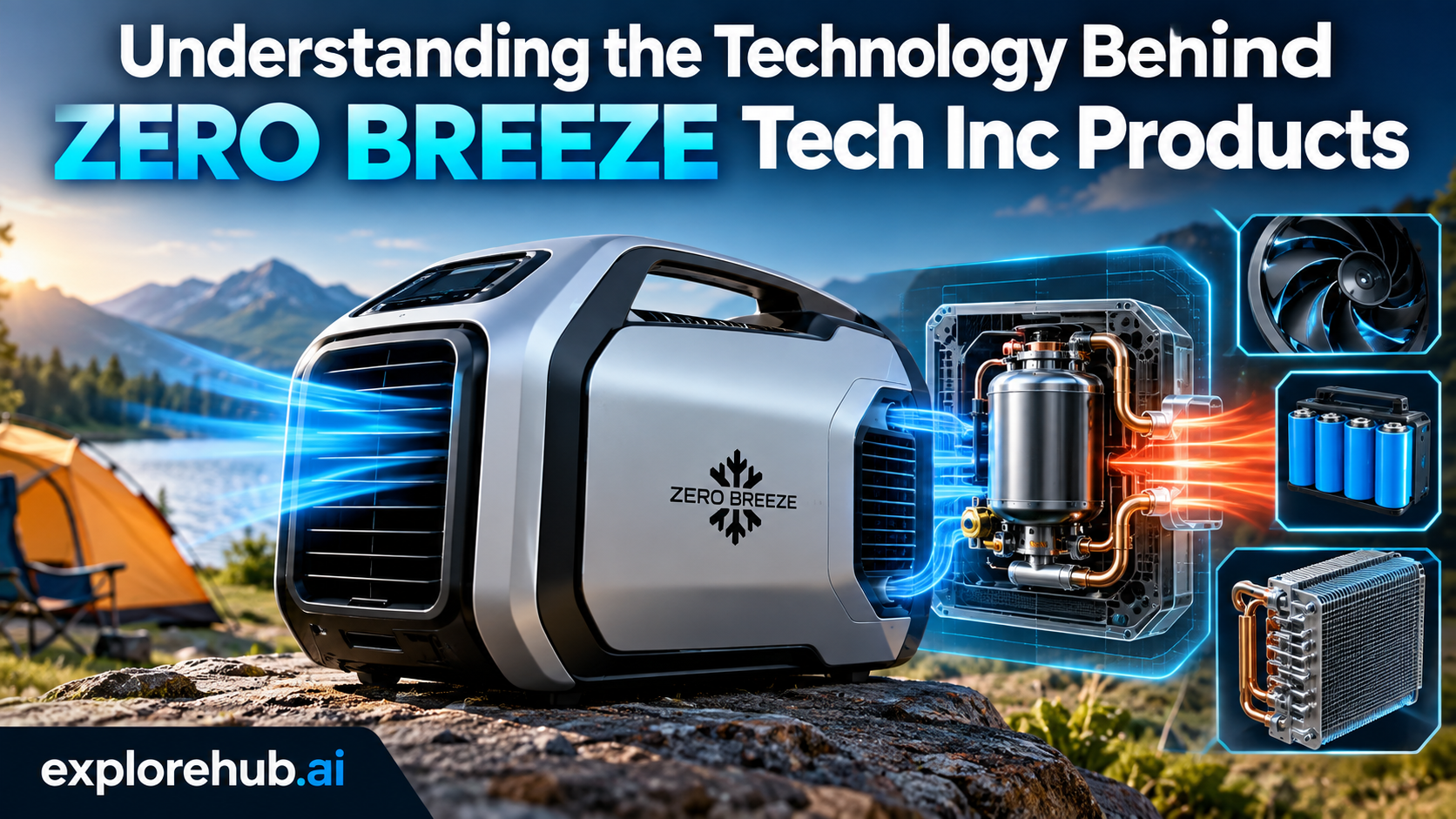
Portable air conditioning has changed a lot in recent years. People no longer want cooling only inside a house or office. Campers, RV owners, travelers, outdoor workers, and people living off-grid often need a cooling solution that can move with them. This is where ZERO BREEZE Tech Inc has built its identity. Instead of simply making a smaller version of a traditional home air conditioner, the company has focused on solving a different problem: how can real air conditioning be made compact, battery-powered, energy-efficient, and practical for outdoor use? The answer involves several technologies working together, including a miniature compressor, 24V DC power, dual-hose heat removal, specialized airflow systems, and portable battery technology. ZERO BREEZE’s Mark 2, for example, uses a 24V DC compressor, 2300 BTU cooling capacity, and approximately 240W of rated cooling input. The company says the Mark 2 weighs about 16.5 pounds and can operate from a compatible battery or external power source. Understanding these technologies makes it much easier to see why ZERO BREEZE products are different from simple fans, evaporative coolers, or ordinary household portable AC units.
Table of Contents
- What Is ZERO BREEZE Tech Inc?
- How ZERO BREEZE Portable Air Conditioning Works
- The Role of the 24V DC System
- Understanding the Dual-Hose Technology
- Key Features of ZERO BREEZE Technology
- Battery Technology Behind ZERO BREEZE Products
- Cooling Performance and BTU Capacity
- Energy Efficiency and Low Power Consumption
- Airflow, Fans, and Heat Management
- Refrigerant Technology
- ZERO BREEZE Mark 2 Technology
- Why ZERO BREEZE Is Different From Evaporative Coolers
- ZERO BREEZE Mark 3 and the Next Step
- Where ZERO BREEZE Technology Can Be Used
- Advantages of the Technology
- Limitations to Understand Before Buying
- ZERO BREEZE vs Traditional Portable ACs
- The Future of Portable Cooling Technology
- Conclusion
- Frequently Asked Questions
What Is ZERO BREEZE Tech Inc?
ZERO BREEZE is a technology company focused on portable air-conditioning systems, particularly for situations where conventional air conditioning is difficult to use. The company began with the idea of creating genuine cooling that people could take outdoors. Its history shows a gradual development from the Mark 1, introduced in 2016 with 1100 BTU capacity, to the Mark 2 and later the Mark 3. According to the company’s history, the Mark 2 arrived in 2019 with 2300 BTU cooling, while the Mark 3 was introduced in 2023 with greater cooling capability. The important point is that ZERO BREEZE does not treat portability as simply making an existing air conditioner smaller. It redesigns several parts of the system around portable power, lower energy consumption, weight, airflow, and outdoor use. Think of it as taking the basic idea of a refrigerator and shrinking the important refrigeration components into a system that can travel with you.
From Portable Cooling to Outdoor Comfort
Traditional air conditioners are generally designed around permanent power and fixed installation. A household system can consume substantial electrical power because it is expected to cool a relatively large area. An outdoor user has a completely different situation. They may have a battery, solar panel, vehicle, or portable power station instead of a wall outlet. They may also want to cool a tent, a small RV sleeping area, a vehicle cabin, or simply a person sitting nearby. ZERO BREEZE designs its products around this smaller and more targeted cooling requirement. The Mark 2, for example, is designed around a 2300 BTU cooling capacity and a 240W rated input, rather than trying to match the cooling output of a large household AC. This design philosophy explains an important feature of the technology: the objective is not necessarily to cool an entire large building, but to deliver useful cooling where it is needed while keeping the electrical demand manageable.
How ZERO BREEZE Portable Air Conditioning Works
At the heart of a ZERO BREEZE compressor-based air conditioner is the same basic refrigeration principle used in conventional air conditioners. The system uses a compressor, condenser, evaporator, fans, and refrigerant to move heat rather than simply producing cold air. Warm air passes across the evaporator, where heat is absorbed by the refrigerant. The compressor then raises the refrigerant’s pressure, and the condenser helps release the collected heat. Fans move air through the system while the refrigerant repeatedly changes state as part of the cooling cycle. ZERO BREEZE explains that its Mark 2 uses this compressor-based approach rather than relying on ice or water. That distinction is important because an evaporative cooler can provide relief in suitable dry conditions, but it does not work in exactly the same way as a true refrigeration-based air conditioner.
The Compressor-Based Cooling System
The compressor is one of the most important pieces of the entire design. Conventional compressors can be relatively large, heavy, and power-hungry, which creates an obvious problem for a portable air conditioner. ZERO BREEZE therefore developed a much smaller compressor system for the Mark 2. The company describes its compressor as a 24V micro inverter compressor and says it is roughly the size of a cola can, making it much smaller than conventional compressor designs. The compressor’s job remains familiar: it compresses refrigerant vapor and keeps the refrigeration cycle moving. What changes is the scale and electrical design. By combining a miniature compressor with a DC electrical system, ZERO BREEZE can build a cooling machine that is much easier to carry than a typical compressor-based AC.
Why a Micro Compressor Matters
A small compressor is not simply a marketing feature. It affects almost every part of the product. A smaller compressor can reduce the physical size of the air conditioner, leaving room for airflow channels, fans, electronics, battery connections, and other components inside a compact enclosure. It also makes portable operation more practical because the complete system does not need to be built around a large motor and compressor. ZERO BREEZE says the Mark 2’s miniature compressor was developed specifically with small size, light weight, low power consumption, and DC operation in mind. This is one reason the technology is interesting: the company had to optimize several engineering targets at the same time. Making the compressor smaller alone would not solve the problem unless the rest of the cooling system could also move heat efficiently.
The Role of the 24V DC System
Another major technology choice is the 24V DC electrical architecture. Many household appliances are designed to operate from standard AC electricity. Portable power systems, vehicle batteries, and many off-grid battery systems, however, naturally work with DC power. ZERO BREEZE designed the Mark 2 around 24V DC, allowing the air conditioner to work directly with compatible battery systems without always requiring a DC-to-AC inverter. The company’s specifications list the Mark 2’s rated voltage as 24V DC and its cooling-rated input as 240W.
Why does this matter? Every conversion step can introduce energy loss. If a battery provides DC power, converting it to AC and then converting it back internally can add unnecessary complexity and losses. ZERO BREEZE says its 24V approach can reduce current compared with a 12V system at the same power level, which helps with electrical efficiency and battery operation. In simple terms, the 24V design is a bridge between the air conditioner’s refrigeration system and the kind of battery power commonly used in mobile applications.
Understanding the Dual-Hose Technology
One of the most important technologies in a portable air conditioner is heat exhaust. Cooling a room does not mean heat disappears. The system has to remove heat from one place and release it somewhere else. ZERO BREEZE uses a dual-hose design for this purpose. According to the company, one hose brings outside air across the condenser for heat exchange, while the second hose releases the heated air outdoors.
Separating Hot and Cold Air
This separation helps prevent the system from simply moving hot air around inside the same space. Imagine trying to cool a small tent while also dumping the air conditioner’s waste heat into that tent. The cooling effect would quickly become less useful. A dual-hose setup creates a clearer separation between the cooling side and the heat-rejection side. ZERO BREEZE says its Mark 2 uses a dual-hose heat-removal system and is designed to keep internal and external air more effectively separated. This becomes particularly useful in small enclosed spaces where every watt of cooling and every degree of temperature change matters.
Key Features of ZERO BREEZE Technology
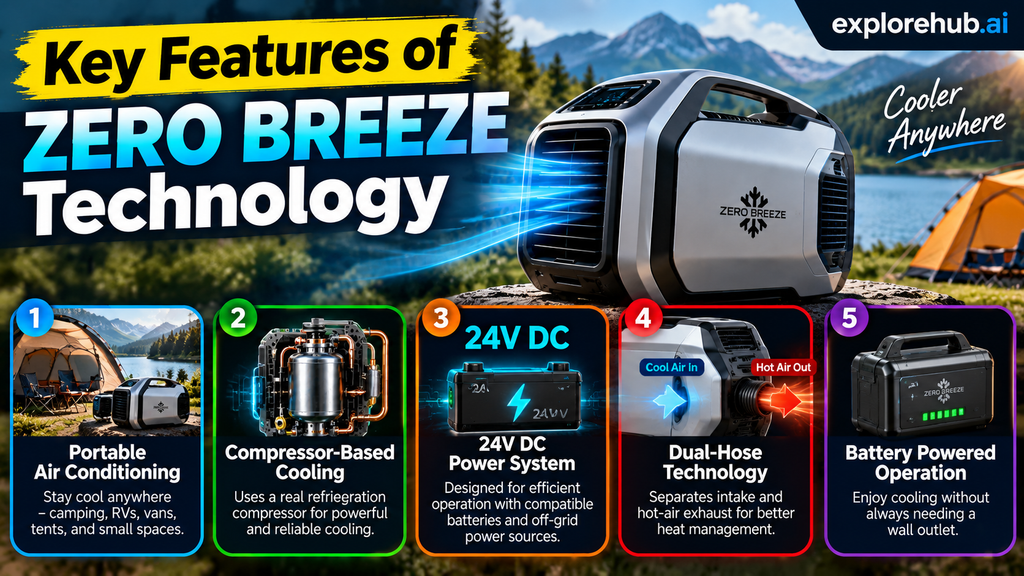
Portable Air Conditioning – Compact cooling designed for camping, RVs, vans, tents, and small spaces.
Compressor-Based Cooling – Uses a real refrigeration compressor instead of ice or water evaporation.
24V DC Power System – Designed for efficient operation with compatible batteries and off-grid power sources.
Dual-Hose Technology – Separates intake and hot-air exhaust to improve heat management.
Battery Powered Operation – Supports portable cooling without depending entirely on a wall outlet.
Battery Technology Behind ZERO BREEZE Products
Portable cooling becomes much more useful when the air conditioner does not depend entirely on a wall outlet. ZERO BREEZE therefore developed a removable battery system for the Mark 2. The official specifications list the Mark 2 battery as an 18650 lithium-ion polymer battery, with a 24V, 35Ah, 840Wh capacity. The company lists a charging time of approximately six hours using its official power adapter and says the battery can also be charged through suitable solar and vehicle charging setups.
Portable and Off-Grid Power
The battery is designed to become part of the cooling system rather than simply being an accessory. ZERO BREEZE offers versions of the Mark 2 with different battery configurations, including a basic version without a battery, a Plus version with one battery, and a Plus Extra version with two batteries. The company gives approximately 3–5 hours of cooling for a single Mark 2 battery, while its FAQ states that two batteries can provide up to around 12 hours under suitable conditions. Actual runtime depends on factors such as ambient temperature, humidity, insulation, operating mode, and power demand.
This approach makes the system useful for camping, RVs, emergency situations, and other locations where electrical infrastructure may be limited. A user can charge the battery before leaving, connect it to vehicle power, or use compatible solar charging equipment. That flexibility is one of the strongest parts of the overall technology because the refrigeration system and the power system have been designed to work together.
Cooling Performance and BTU Capacity
BTU, or British Thermal Unit, is commonly used to describe the cooling capacity of an air conditioner. The Mark 2 is rated at 2300 BTU, which is much smaller than many household air conditioners. At first glance, that number may seem low, but the intended use matters. ZERO BREEZE is not trying to compete directly with a large residential AC designed to cool an entire house. The company says the Mark 2 is best suited to roughly 25–40 square feet under specific test conditions involving high outdoor temperatures, reasonable insulation, and limited direct sunlight.
The company also reports that the Mark 2 can reduce the temperature of air coming from the outlet by about 30°F within ten minutes under certain laboratory conditions. This should not be interpreted as a promise that every room will fall by 30°F in ten minutes. Real-world performance depends heavily on room size, insulation, humidity, sunlight, number of people, and how the exhaust hoses are installed. The better way to understand the technology is as targeted cooling rather than a replacement for a central air-conditioning system.
Energy Efficiency and Low Power Consumption
Energy efficiency is central to the ZERO BREEZE concept. A portable AC that consumes hundreds or thousands of watts continuously would quickly drain a battery and become difficult to use outdoors. The Mark 2 has a listed cooling-rated input of 240W, which is one of the reasons the system can operate from relatively compact battery solutions.
This low power requirement also explains why the company chose a smaller cooling capacity. Cooling capacity, compressor size, fan operation, and battery capacity are connected like links in a chain. Increase the cooling output significantly, and the electrical demand normally rises as well. That means a larger battery would be needed, making the system heavier and less portable. ZERO BREEZE has therefore made a design trade-off: provide useful cooling for smaller spaces while keeping the system practical to carry and power.
Airflow, Fans, and Heat Management
A good compressor alone does not make a good portable air conditioner. The system also needs effective airflow. ZERO BREEZE uses different airflow paths to move cooled air toward the user while carrying heat away from the condenser. The company describes the Mark 2 as using a variable-frequency centrifugal fan system and reports airflow of up to about 120 CFM in its technical discussion.
This is particularly important because portable equipment has very little room for large air channels. The engineers have to balance airflow, noise, pressure, duct length, and power consumption. If airflow is restricted, heat exchange can become less effective. If the fans are too powerful, energy consumption and noise can rise. ZERO BREEZE therefore combines compact fans with its compressor and duct system to create a complete thermal-management solution rather than focusing on a single component.
Refrigerant Technology
The refrigeration cycle needs a working fluid capable of absorbing and releasing heat. The Mark 2 uses R134a refrigerant, according to ZERO BREEZE’s current product information and FAQ. The refrigerant travels through the system and changes pressure and state as it moves between the evaporator, compressor, condenser, and expansion components.
The important concept is that the refrigerant does not simply create cold. Instead, it provides a mechanism for moving heat. Inside the cooling area, the refrigerant absorbs heat as it passes through the evaporator. The compressor then raises its pressure, and the condenser allows the system to release that heat through the exhaust side. Once the refrigerant returns to the appropriate state, the cycle repeats. This is the same fundamental principle behind many conventional refrigeration systems, but ZERO BREEZE packages it into a much smaller mobile platform.
ZERO BREEZE Mark 2 Technology
The Mark 2 is perhaps the clearest example of ZERO BREEZE’s engineering approach. Its core specifications include 2300 BTU cooling, 240W rated input, 24V DC operation, 52 dB(A) sound level, R134a refrigerant, dual-hose exhaust, and a 16.5-pound AC-unit weight. The unit measures approximately 20 × 10 × 11 inches, showing how much equipment has been compressed into a relatively small enclosure.
Its battery architecture adds another layer. The dedicated 840Wh battery can attach to the unit and provides several hours of portable operation under suitable conditions. The system can also use shore power, vehicle charging, solar charging, or compatible external battery sources. This combination of refrigeration and mobile power is what makes the Mark 2 more than simply a small AC.
At the same time, ZERO BREEZE’s current website states that the Mark 2 is sold out with no further production planned, directing customers toward the newer Mark 3. That makes the Mark 2 especially useful as an example of the technology that helped establish the company’s portable AC approach.
Why ZERO BREEZE Is Different From Evaporative Coolers
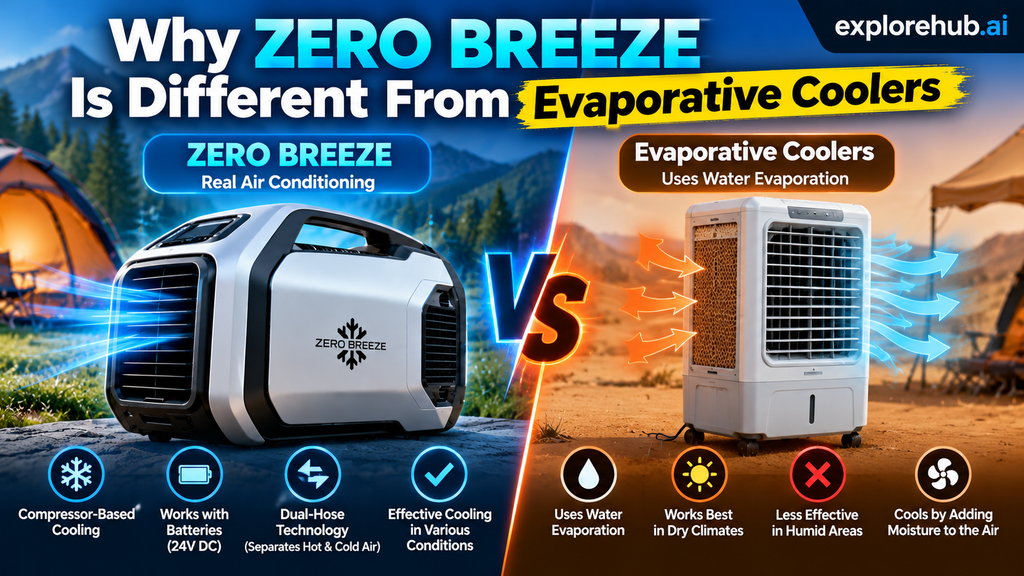
Portable cooling products can look similar from the outside even when their technology is completely different. An evaporative cooler generally uses water evaporation to reduce air temperature. That can work well in appropriate dry environments, but humidity affects its performance. A compressor-based air conditioner does not depend on evaporation in the same way. ZERO BREEZE specifically describes the Mark 2 as a real compressor-driven air conditioner, rather than an evaporative or ice-based cooler.
This difference is important for buyers. If someone expects genuine refrigeration-based cooling, they need to understand the technology inside the product. ZERO BREEZE does not require users to constantly add ice or water to create the cooling effect. Instead, the refrigeration system performs a continuous heat-transfer cycle. The result is a product that behaves more like a miniature traditional AC than a fan with a cooling reservoir.
ZERO BREEZE Mark 3 and the Next Step
The company’s product development did not stop with Mark 2. ZERO BREEZE says it introduced the Mark 3 in 2023 to provide greater cooling capacity and support a wider range of outdoor applications. The move from Mark 1 to Mark 2 and then Mark 3 shows a consistent engineering direction: increase cooling capability while maintaining the portability and power advantages that define the product category.
The exact design choices can vary between generations, so buyers should always check the current specifications rather than assuming every Mark model works identically. Still, the development path gives us a useful view of where portable AC technology is going. Smaller compressors, better power electronics, improved airflow, larger energy storage, and smarter thermal management can all contribute to stronger portable cooling without turning the equipment into a heavy household appliance.
Also Read:
Why the ItsEasy Passport App Is Useful for Busy International Travelers
Plan Your Next Adventure with ExperienceFirst: Tips for Travelers
Why Travelers Choose Save A Train for Convenient Train Ticket Booking
Top Features to Consider When Buying a NANUK Protective Case
Top Benefits of Using TravelloApp for Personalized Travel Planning and Exploration
Where ZERO BREEZE Technology Can Be Used
The technology is especially suitable for camping, RVs, vans, tents, vehicles, outdoor work areas, emergency settings, and other small spaces. ZERO BREEZE says its products have also found applications in areas such as emergency vehicles, small aircraft, race cars, marine vessels, construction sites, and medical settings.
The common factor is not the location itself. It is the cooling problem. These environments may have limited electrical infrastructure, limited space, or a need for temporary cooling. A conventional AC can be too large, too difficult to install, or too power-hungry. A fan may not provide enough cooling. A portable compressor-based system fills the gap between those two choices.
Advantages of the Technology
The biggest advantage is portability without giving up compressor-based cooling. Users can carry the AC unit, connect appropriate ducts, attach a battery, and create a mobile cooling setup. The 24V DC architecture also makes the product suitable for certain off-grid power systems, while the removable battery provides additional flexibility.
Other advantages include targeted cooling, comparatively low power consumption, flexible charging options, and the ability to use the equipment in places where installing a traditional AC would be impractical. The dual-hose system is another major benefit because it gives the system a dedicated method for handling condenser heat. These features work together rather than independently. The real innovation is the combination.
Limitations to Understand Before Buying
Portable cooling technology also has limits. A 2300 BTU unit cannot realistically be expected to perform like a large household AC in a big, poorly insulated room. ZERO BREEZE itself explains that cooling performance depends on factors such as space size, insulation, sunlight, humidity, and the number of people inside.
Battery runtime is another consideration. An 840Wh battery does not mean the AC will always run for exactly the same number of hours. Compressor load, ambient temperature, operating mode, battery condition, and other factors influence runtime. The company provides a general 3–5-hour figure for the Mark 2 battery, but real-world use can vary. Buyers should therefore think about their actual environment instead of choosing a product based only on the BTU number or advertised runtime.
ZERO BREEZE vs Traditional Portable ACs
| Feature | ZERO BREEZE Mark 2 | Traditional Portable AC |
| Main purpose | Mobile and outdoor cooling | Indoor room cooling |
| Cooling capacity | 2300 BTU | Often substantially higher |
| Power system | 24V DC | Usually AC mains |
| Rated input | 240W | Often much higher |
| Battery operation | Supported | Usually requires external power/inverter |
| Exhaust system | Dual hose | Varies by model |
| Portability | Designed for frequent movement | Usually moved occasionally |
| Best use | Tents, RVs, vehicles, small spaces | Rooms and larger indoor spaces |
The comparison shows why these products should not be judged using only traditional AC standards. A conventional portable AC may offer more cooling capacity, but it may also require much more electricity and may be less convenient for off-grid use. ZERO BREEZE instead focuses on the problem of delivering practical cooling when power, space, and mobility are limited. Its Mark 2 specifications reflect that philosophy with a 240W input and 24V DC architecture.
Latest Posts:




The Future of Portable Cooling Technology
The future of portable cooling will likely depend on solving several problems at once. Users want more cooling, longer battery life, lower weight, less noise, and easier charging. These goals can conflict with each other, which makes the engineering challenge interesting. A larger compressor can increase cooling capacity but usually requires more power. A larger battery can increase runtime but also adds weight. Better insulation can reduce the cooling load, but the surrounding structure may become more expensive or complex.
Companies such as ZERO BREEZE are working in the middle of this engineering puzzle. The Mark 2 demonstrated how a miniature compressor, DC power system, battery, airflow management, and dual-hose heat rejection could be combined into a portable package. The development of the Mark 3 suggests that the company is continuing to improve the concept.
As battery technology improves, portable air conditioners may become even more practical. Better lithium-ion cells, improved power electronics, more efficient compressors, smarter control systems, and improved thermal materials could eventually provide more cooling from smaller and lighter equipment. Solar charging and high-capacity portable power stations can also make off-grid air conditioning increasingly practical.
Conclusion
The technology behind ZERO BREEZE Tech Inc products is based on a simple but challenging idea: create genuine air conditioning that people can take almost anywhere. The company achieves this by combining a miniature compressor with a 24V DC electrical system, specialized airflow, dual-hose heat rejection, refrigerant-based cooling, and portable battery technology. The Mark 2 demonstrates this approach particularly well, offering 2300 BTU cooling, approximately 240W rated input, and a compact 16.5-pound AC unit.
What makes ZERO BREEZE interesting is not one single component. The innovation comes from how the components work together. The compressor provides real refrigeration, the fans move air, the dual hoses remove heat, the 24V system supports efficient mobile power, and the battery makes the entire setup usable away from a traditional electrical outlet. For campers, RV users, outdoor workers, and people who need cooling in small spaces, this combination can offer a practical alternative to conventional air conditioning.