

Travelling from New Zealand to the United States can be an exciting experience, whether you are planning a holiday in New York, a road trip through California, a family visit, or a business trip. The USA offers huge cities, national parks, beaches, theme parks, shopping destinations, and countless cultural experiences. At the same time, the country has different entry procedures, transport systems, weather conditions, and everyday costs that can surprise first-time visitors. A little preparation before leaving New Zealand can make the whole journey much easier.
For Kiwi travellers, one of the most important things to understand is that US entry approval is not automatic simply because you have a New Zealand passport. New Zealand is part of the US Visa Waiver Program, which allows eligible citizens to travel for tourism or business for up to 90 days without obtaining a traditional visa, but travellers still need an approved ESTA and must meet the program requirements.
Table of Contents
- What Kiwi Travellers Should Know Before Visiting the USA
- Check Your Passport and Travel Eligibility
- Understand the Visa Waiver Program
- Apply for ESTA Before Your Flight
- Know When You May Need a US Visa
- Key Features of Kiwi US
- Plan Your Flights and Arrival Airport
- Prepare for US Customs and Border Control
- Keep Your Accommodation Details Ready
- Choose the Right Travel Insurance
- Plan Your US Transport
- Understand Money, Cards, and Tipping
- Pack Smart for Different US Regions
- Be Ready for Weather and Natural Hazards
- Stay Connected During Your Trip
- Understand American Driving Rules
- Advantages and Disadvantages of Kiwi US Travel
- Stay Safe in Busy Tourist Areas
- Plan Your Return to New Zealand
- Kiwi US Travel Checklist
- Conclusion
- Frequently Asked Questions
What Kiwi Travellers Should Know Before Visiting the USA
The best way to approach a US trip is to think of preparation as building a safety net. You may never need some of the documents, backup plans, or insurance you arrange, but having them ready can save considerable stress when something unexpected happens. The United States is a large country, and conditions can vary dramatically between destinations. A summer trip to Arizona is very different from a winter trip to New York, while travelling around California by car requires a different plan from spending a week in Manhattan.
Start by checking your passport, ESTA or visa requirements, travel insurance, flights, accommodation, transport, and important addresses before departure. Keep digital copies of your passport and insurance documents, but also carry accessible offline copies because mobile data or Wi-Fi may not always work when you need them. SafeTravel recommends carrying copies of important documents and having emergency funds available while travelling overseas.
Why Preparation Matters for a US Trip
A common mistake is assuming that everything will work exactly as it does in New Zealand. The US is familiar in many ways, but everyday systems can be different. Distances are often much greater than they look on a map, some cities are difficult to navigate without a car, and domestic flights can involve large airports and long security lines.
Your travel plan should therefore include realistic time between activities. Avoid filling every day with attractions that are far apart. If your hotel is in one part of a city and your planned activities are in another, check actual travel times rather than relying on straight-line distances. A relaxed itinerary gives you room to handle flight delays, traffic, weather, tiredness, and unexpected changes without turning your holiday into a race.
Check Your Passport and Travel Eligibility
Your New Zealand passport is the starting point for your US trip. Eligible New Zealand citizens can use the Visa Waiver Program for tourism or business travel of up to 90 days, provided they satisfy the program’s conditions and obtain ESTA approval. The US Department of State states that travellers using the VWP need an appropriate passport and ESTA authorization before travelling.
The US Department of State currently states that VWP travellers need an e-passport containing an electronic chip. You can identify an e-passport by the electronic passport symbol on the cover. The Department also says passports generally need to be valid for at least six months after planned departure from the United States unless a country-specific exemption applies.
Before booking a non-refundable trip, check your passport expiry date and make sure the details match the information you will use for your ESTA. If you renew your passport after receiving ESTA approval, you generally need a new ESTA because ESTA authorization is connected to your passport information. CBP also says a new ESTA may be required after a name or citizenship change or when circumstances affecting the previous application change.
Understand the Visa Waiver Program
The Visa Waiver Program, commonly called the VWP, is one of the most useful arrangements for eligible Kiwi tourists. Under the program, eligible citizens of participating countries can visit the United States for tourism or business for stays of 90 days or less without first obtaining a traditional visitor visa. New Zealand is listed among the participating countries.
However, being eligible for visa-free entry does not mean you can enter the country without meeting its immigration requirements. You still have to meet the VWP requirements, use an eligible passport, obtain ESTA approval, and satisfy US immigration requirements at the border. CBP officers make the final determination about admission when you arrive, so an approved ESTA should not be treated as a guarantee of entry. New Zealand SafeTravel also warns that US border authorities may conduct detailed checks and that entry rules are strictly enforced.
There are also circumstances where a New Zealand citizen may not be eligible to use the VWP. For example, US rules contain restrictions connected with certain travel histories and dual nationalities. CBP explains that some travellers who have visited or been present in specified countries may need to obtain a visa instead of using the VWP.
Apply for ESTA Before Your Flight
ESTA, or the Electronic System for Travel Authorization, is essential for eligible New Zealand travellers using the Visa Waiver Program. It is not a visa. Instead, it is an electronic authorization that determines whether a traveller is eligible to travel to the United States under the VWP. CBP recommends applying for ESTA when booking travel rather than leaving the process until the last minute.
Use the official ESTA website rather than relying on unofficial websites that may add unnecessary service charges. Carefully enter your passport information, personal details, contact information, travel information, and security-related answers. Review every detail before submitting because mistakes involving key passport or identity information can require a new application.
The ESTA application is particularly important because airline boarding and US arrival procedures depend on having the appropriate authorization. Keep your approval information accessible even though ESTA is electronically connected with your passport. A screenshot or printed record can also be useful as part of your general travel documentation.
Current ESTA Cost and Validity
As of 2026, CBP information states that the ESTA fee is US$40.27, while CBP’s fee information describes the approved ESTA cost as approximately US$40. The fee structure changed in September 2025.
CBP states that an ESTA authorization is typically valid for two years or until the passport expires, whichever comes first. However, validity does not mean you can remain in the United States for two years. Under the VWP, eligible visitors generally receive permission to travel for stays of up to 90 days, subject to US immigration requirements.
| Item | Current guidance |
| Program | Visa Waiver Program |
| New Zealand eligibility | New Zealand is a VWP country |
| Typical VWP stay | Up to 90 days |
| ESTA | Required for VWP travel |
| ESTA status | Usually up to 2 years or passport expiry |
| Current ESTA cost | About US$40 |
| Passport | E-passport required for VWP |
Always check the official US government information immediately before departure because fees and immigration requirements can change.
Know When You May Need a US Visa
Not every New Zealand traveller will qualify for the Visa Waiver Program. If your circumstances mean you cannot use the VWP, you may need to apply for a US visa before travelling. This can apply to certain travel histories, purposes of travel, or personal circumstances.
For example, CBP explains that specific travel or nationality circumstances can make a person ineligible for VWP travel and require a visa instead. If you are uncertain about your eligibility, do not guess based on what happened to a friend or another traveller. Immigration rules depend on individual circumstances.
It is also important to remember that tourism, business, study, employment, and immigration are not interchangeable travel purposes. A trip planned for ordinary tourism may fit the VWP, while a different purpose may require a different visa category. Check the official US State Department information for your exact situation before booking travel.
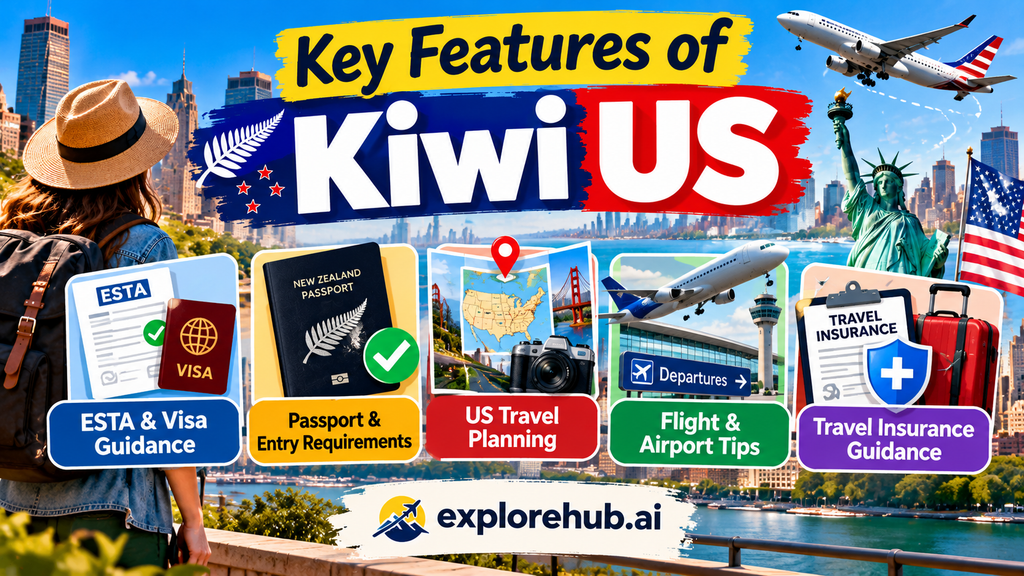
Key Features of Kiwi US
ESTA & Visa Guidance
Understand ESTA requirements, Visa Waiver Program rules, and when a US visa may be required.
Passport & Entry Requirements
Learn about passport validity, e-passport requirements, and important US entry conditions.
US Travel Planning
Plan your itinerary, destinations, accommodation, and activities for a smoother trip.
Flight & Airport Tips
Get useful advice on booking flights, connections, baggage, arrival airports, and airport transfers.
Travel Insurance Guidance
Understand why comprehensive medical and travel insurance is important when visiting the USA.
Plan Your Flights and Arrival Airport
Long-distance travel from New Zealand to the United States can be tiring, so choosing a practical flight schedule can make a noticeable difference. Consider your arrival time, connection length, baggage arrangements, and the distance between the airport and your accommodation. A very cheap ticket is not necessarily a good deal if it creates a difficult overnight connection or leaves you with a long journey immediately after landing.
Think carefully about your first day. If you arrive after a long international flight, avoid scheduling too many activities immediately. Give yourself time to pass immigration, collect baggage, travel to your accommodation, eat, and recover from the time-zone change.
The airport you choose can also influence the rest of your trip. If you are visiting several US cities, compare open-jaw or multi-city flights rather than automatically returning to your original arrival airport. For road trips, think about whether returning a rental car to a different location will increase the cost.
Prepare for US Customs and Border Control
US arrival procedures can feel more formal than some Kiwi travellers expect. New Zealand SafeTravel states that US authorities may scrutinize travel documents, reasons for travel, belongings, electronic devices, and communications, and advises travellers to comply with entry requirements.
Keep your answers simple and truthful. Be prepared to explain why you are visiting, how long you expect to stay, where you will stay, and what your travel plans are. Carry the address of your accommodation, including the ZIP code, because SafeTravel specifically advises New Zealand travellers to have the full US address available for Customs purposes.
Do not bring restricted food, agricultural products, or other prohibited items simply because they are normal household items in New Zealand. If you are unsure about an item, check US Customs and Border Protection rules before packing. When in doubt at the border, declaring an item is generally safer than hiding it and creating a larger problem.
Keep Your Accommodation Details Ready
Your first hotel or accommodation information should be easy to find. Save the property name, street address, ZIP code, telephone number, and booking confirmation in your phone. It is also sensible to keep an offline copy because you may not have mobile data immediately after landing.
If you are staying with friends or family, keep their address and contact details available. Make sure the address is accurate and matches your travel plans. If your itinerary changes, update your records rather than relying on an old booking confirmation.
This small preparation can make airport arrival much smoother. Instead of searching through multiple emails while standing at immigration, you can quickly provide the information you need.
Choose the Right Travel Insurance
Travel insurance should be considered an essential part of a US trip rather than an optional extra. New Zealand SafeTravel specifically advises New Zealanders travelling to the United States to have comprehensive travel and medical insurance.
Medical treatment in the United States can be extremely expensive. Even a relatively simple accident can create significant costs, while hospital treatment can become much more expensive. SafeTravel states that New Zealand government assistance does not cover medical expenses overseas and recommends comprehensive insurance.
Why Medical Cover Matters
When comparing insurance policies, do not look only at the headline price. Check the medical benefit limit, emergency evacuation, hospital treatment, cancellation cover, baggage protection, rental-car conditions, and exclusions. If you are planning skiing, hiking, diving, motorcycling, or other activities, make sure the policy covers them.
Also read the policy conditions relating to pre-existing conditions and medication. SafeTravel recommends making sure the policy reflects the traveller’s needs and planned activities.
A good travel insurance policy works like a financial seatbelt. You hope you never need it, but the purpose is to reduce the impact of an unexpected event.
Plan Your US Transport
Transportation is one of the biggest differences between US destinations. Some cities have extensive public transport, while others are easier to explore with a rental car. New York City, for example, can be navigated very differently from Los Angeles or many national-park destinations.
Before choosing a hotel, check how you will move around. A cheap hotel far from major attractions may become expensive once you add rideshares, taxis, parking, or rental-car costs. On the other hand, a centrally located hotel may cost more but save time and transportation expenses.
For road trips, calculate distances carefully. The United States is enormous, and a route that looks simple on a map can involve many hours of driving. Build rest stops into long journeys and avoid planning unrealistic driving days.
Understand Money, Cards, and Tipping
The US uses the US dollar, and card payments are widely accepted in many tourist areas. Still, carrying a small amount of cash can be useful for situations where cards are inconvenient or unavailable. Before travelling, tell your bank that you will be using your card in the United States if your bank recommends travel notifications.
Tipping is another area where Kiwi travellers may need to adjust. In many US service industries, tips form an important part of workers’ income, and customers commonly encounter suggested tipping amounts on payment screens and restaurant bills. Check whether a gratuity or service charge has already been included before adding another tip.
Your travel budget should therefore include more than hotel, flight, and attraction prices. Allow room for taxes, tips, transportation, parking, meals, baggage fees, and unexpected purchases. This prevents the common mistake of creating a budget that looks affordable on paper but becomes much larger during the actual trip.
Pack Smart for Different US Regions
The United States has enormous geographic and climate variation. Packing for San Francisco, Florida, Alaska, and New York at the same time would require very different clothing choices. Even within one state, weather can change depending on elevation and season.
Check the forecast for each destination shortly before departure and again during your trip. Use layers where possible because indoor environments may be heavily air-conditioned while outdoor conditions can be warm. Comfortable walking shoes are particularly useful because many US holidays involve much more walking than visitors initially expect.
Keep essential medication, important documents, electronics, and valuables in your carry-on rather than checked baggage. SafeTravel also recommends carrying essential medication in hand luggage in case checked baggage is lost.
Be Ready for Weather and Natural Hazards
Weather planning matters because the United States experiences hurricanes, tornadoes, snowstorms, earthquakes, extreme heat, and other hazards depending on location and season. New Zealand SafeTravel specifically warns travellers about severe weather and natural disasters in the US.
If you are visiting Florida, the Gulf Coast, or parts of the eastern seaboard during hurricane season, monitor official weather information. If travelling through the central United States, understand that severe thunderstorms and tornadoes can occur. In winter, snow and ice can cause flight delays, road closures, and changes to travel plans.
Do not treat weather warnings as background information. If local authorities issue an evacuation or emergency instruction, follow it. Keep your phone charged and make sure you know how to receive local emergency alerts.
Stay Connected During Your Trip
Reliable communication makes travel easier, especially during a long international holiday. Before departure, check whether your New Zealand mobile provider offers US roaming and compare the cost with an eSIM or local SIM option.
Download offline maps for the destinations you will visit. Save hotel addresses, reservation numbers, airline information, and important contacts where you can access them without an internet connection.
It is also useful to carry a portable charger. Airports, buses, rental cars, and long sightseeing days can quickly drain a phone battery. A working phone is not just convenient; it can help you access maps, transportation information, reservations, and emergency contacts.
Understand American Driving Rules
A US road trip can be one of the best ways to explore areas outside major cities, but driving requires preparation. Check the rental company’s requirements before booking, including driver’s licence rules, age restrictions, insurance, deposit requirements, and payment-card conditions.
Remember that traffic laws can differ between states. Speed limits, toll systems, parking rules, road signs, and mobile-phone laws may not be identical everywhere. Never assume that a rule from one state automatically applies in another.
If you plan a long road trip, avoid driving when extremely tired. The excitement of reaching the next destination can make travellers underestimate fatigue. Build reasonable driving periods into your itinerary and use designated rest areas when necessary.
Also Read:
Quidco UK New Member Acquisition CPL: A Smart Way to Monetize Travel Content
Ski-planet FR for Beginners: A Complete Ski Travel Guide
H10 Hotels (US & Canada): Where Travelers Find Comfort and Class
Discovering Modern Hospitality Experiences with Vibra Hotels (US)
Your Ultimate Guide to Portable Energy Solutions from Jackery US
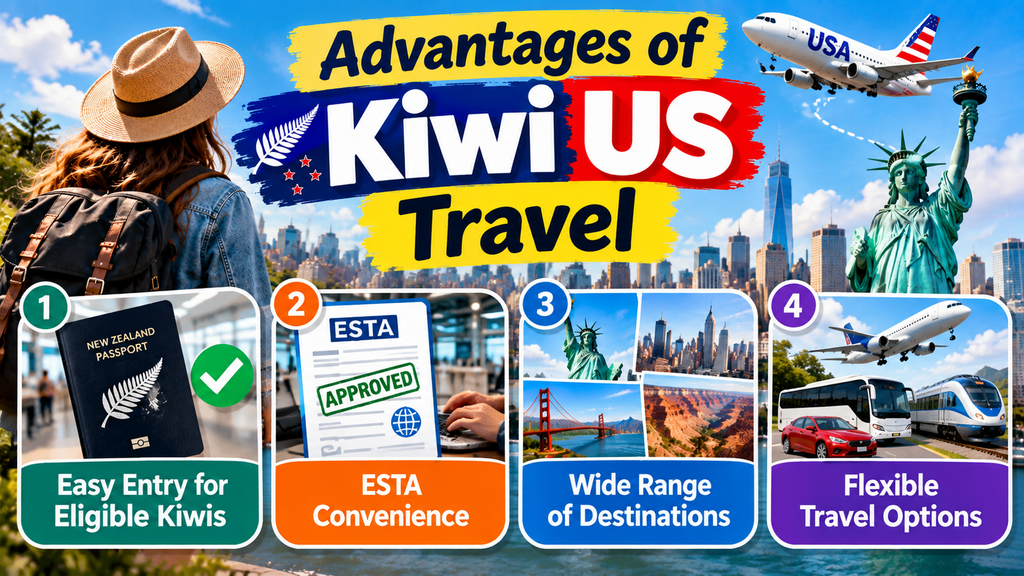
Advantages and Disadvantages of Kiwi US Travel
Advantages
- Easy Entry for Eligible Kiwis – Eligible New Zealand citizens can use the Visa Waiver Program for qualifying tourism or business trips of up to 90 days.
- ESTA Convenience – ESTA provides a simpler electronic travel authorization process than applying for a traditional visitor visa when eligible.
- Wide Range of Destinations – Travellers can explore major cities, beaches, national parks, entertainment destinations, and cultural attractions.
- Flexible Travel Options – The USA offers flights, rental cars, public transport, trains, and rideshare services across different destinations.
Disadvantages
- Long Travel Distance – Flying from New Zealand to the USA can involve long flight times and significant time-zone changes.
- High Medical Costs – Healthcare in the USA can be very expensive, making comprehensive travel insurance important.
- Different Tipping Culture – Tipping is common in many US service industries and can make the final cost higher than expected.
- Large Distances Between Destinations – Travelling between cities and attractions can require long drives or additional domestic flights.
Stay Safe in Busy Tourist Areas
New Zealand SafeTravel currently advises travellers to the United States to exercise increased caution and highlights risks including theft, violent crime, civil unrest, and severe weather. This does not mean every destination is dangerous, but it does mean sensible awareness is important.
Keep your phone, passport, wallet, and other valuables secure in crowded locations. Avoid displaying large amounts of cash and be cautious when using ATMs. When using public transport or visiting major tourist attractions, keep an eye on your belongings.
Also pay attention to local instructions during demonstrations, major events, severe weather, or emergencies. SafeTravel advises New Zealanders to monitor local information and follow instructions from authorities.
Plan Your Return to New Zealand
A smooth trip includes planning the journey home before you leave New Zealand. Keep track of your return flight, baggage allowance, airport transfer, and check-in time. If you are travelling between multiple US cities before your international departure, allow enough time to reach the airport.
Remember that returning to New Zealand involves its own border and biosecurity requirements. SafeTravel advises travellers to prepare for the New Zealand Traveller Declaration when returning home.
Do not pack food, plants, animal products, or other items without checking New Zealand’s biosecurity requirements. A souvenir that seems harmless can create problems at the border if it is restricted or undeclared.
Latest Posts:




Kiwi US Travel Checklist
Before leaving New Zealand, use a simple checklist rather than relying on memory. Your documents should be checked first, followed by money, insurance, accommodation, transportation, and health preparations.
- Passport: Check validity and make sure it is an eligible e-passport for VWP travel.
- ESTA: Confirm that your ESTA is approved and linked to your current passport.
- Flights: Check departure times, connections, baggage rules, and arrival airport.
- Accommodation: Save the full address and booking details.
- Insurance: Confirm comprehensive medical and travel coverage.
- Money: Carry suitable payment cards and a backup payment option.
- Medication: Keep essential medication in your carry-on.
- Transport: Decide whether you will use public transport, rideshare services, or a rental car.
- Weather: Check destination forecasts before leaving and during the trip.
- Emergency contacts: Save New Zealand consular and insurance contacts.
- Copies: Keep copies of your passport, insurance, and important bookings.
- Return: Prepare for New Zealand entry and Traveller Declaration requirements.
SafeTravel also recommends registering travel plans and contact details so travellers can receive updates relevant to their destination.
Conclusion
A US trip from New Zealand does not need to be complicated. The secret is to handle the important details before the excitement of the holiday takes over. Check your passport, understand the Visa Waiver Program, apply for ESTA through the official system, arrange comprehensive insurance, prepare your accommodation details, and create a realistic transport plan.
The biggest lesson is simple: do not treat preparation as paperwork; treat it as part of the trip itself. Knowing the entry requirements, having the right documents, understanding your insurance, and preparing for different weather and transport conditions can prevent many avoidable problems.