
The budget hotel industry has changed dramatically over the past decade. Travelers no longer view affordable accommodation as a compromise between comfort and cost. Instead, they expect clean rooms, reliable Wi-Fi, secure payments, flexible check-in options, and professional customer support, even when paying budget-friendly rates. The rise of online booking platforms, mobile apps, and digital reviews has pushed hotel operators to improve their services significantly. Today, a traveler can compare dozens of properties within minutes and make decisions based on ratings, photographs, amenities, and guest experiences.
Budget travel has also become more mainstream. Remote work, weekend getaways, domestic tourism, and affordable transportation have encouraged more people to travel frequently. Business travelers, students, solo adventurers, and families are increasingly choosing budget accommodations to reduce expenses without sacrificing convenience. This growing demand has created fierce competition among hotel brands. Companies like OYO, Treebo, FabHotels, ibis Budget, and several international chains are all competing for the same customer base. As a result, travelers now have more choices than ever before. The key question is no longer whether budget hotels are worth booking. Instead, travelers want to know which budget hotel brand delivers the best value, reliability, and overall experience.
Table of Contents
- Why Budget Travel Is Growing Rapidly
- What Makes OYO Different From Traditional Hotel Chains
- Major Budget Hotel Chains Competing With OYO
- Comparing OYO and Other Budget Hotel Chains
- OYO’s Strengths in 2026
- Areas Where Competitors Perform Better
- Who Should Choose OYO?
- Who Should Consider Other Budget Hotel Chains?
- Final Verdict
- Conclusion
- Frequently Asked Questions
Why Budget Travel Is Growing Rapidly
Budget travel has evolved from a niche segment into a major part of the global hospitality industry. Rising travel demand, digital booking platforms, and flexible work arrangements have encouraged people to travel more frequently while managing costs effectively. Many travelers now prioritize experiences over luxury accommodation. They would rather spend money exploring local attractions, restaurants, and activities instead of paying premium rates for hotel rooms.
Another important factor is the growing confidence in online reviews. Travelers can quickly verify whether a property meets expectations before booking. This transparency has forced budget hotel chains to improve standards and maintain better service quality. The result is a highly competitive marketplace where brands constantly innovate to attract guests. Companies that offer convenience, affordability, and consistency are more likely to succeed in this environment.
What Makes OYO Different From Traditional Hotel Chains
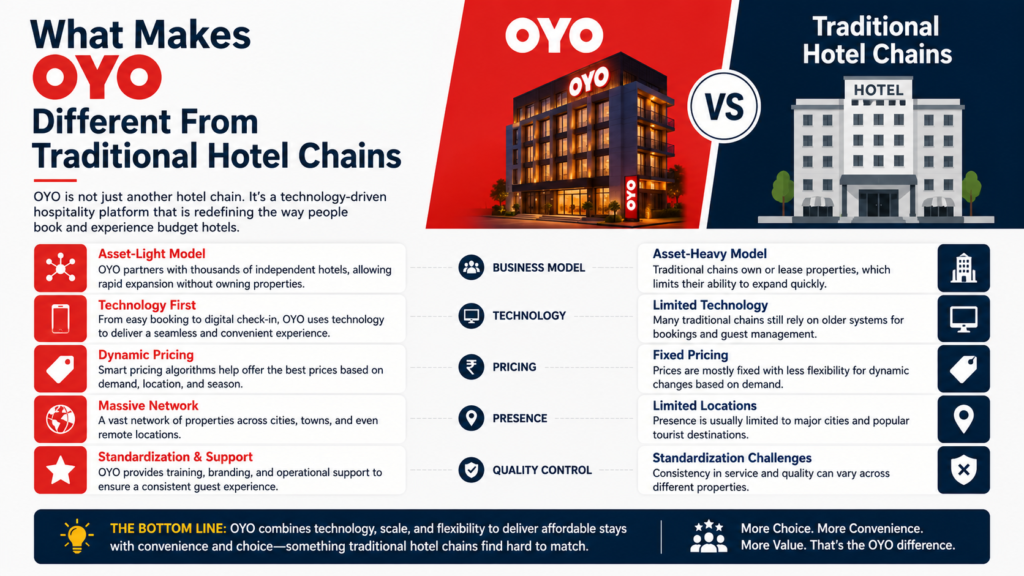
OYO revolutionized the hospitality sector by introducing a technology-driven approach to budget accommodation. Unlike traditional hotel chains that own or directly manage most properties, OYO primarily partners with independent hotels and standardizes their operations under the OYO brand. This asset-light strategy enabled the company to expand rapidly across multiple countries and thousands of properties.
Founded by Ritesh Agarwal, OYO quickly became one of the most recognizable hospitality brands in India and expanded internationally. The company’s focus on technology, dynamic pricing, digital bookings, and operational support helped small hotels increase occupancy while providing travelers with a standardized booking experience. Recent financial reports indicate that OYO has continued strengthening its business, reporting strong revenue growth and profitability improvements during FY25 and FY26. The company reported significant increases in revenue, gross booking value, and profitability while expanding premium offerings and international operations.
The OYO Business Model Explained
OYO’s business model resembles a combination of a hotel franchise network and a technology platform. Independent hotel owners join the OYO ecosystem, adopt standardized branding and operational guidelines, and gain access to the company’s booking technology. Travelers benefit from easier reservations, while hotel owners gain greater visibility and occupancy rates.
This model enabled OYO to scale faster than many traditional hotel brands. Instead of constructing new hotels, OYO focused on bringing existing properties under its network. While this strategy accelerated growth, it also created challenges related to maintaining consistent quality across thousands of partner hotels. As a result, guest experiences can vary more significantly compared to traditional hotel chains that exercise tighter control over operations.
Major Budget Hotel Chains Competing With OYO
The budget hospitality sector includes several strong competitors that challenge OYO in different ways. Some focus heavily on quality control, while others emphasize premium experiences within the budget segment. Understanding these competitors helps travelers evaluate which option best suits their needs.
Treebo Hotels
Treebo has built its reputation around quality assurance and operational consistency. Unlike some large-scale aggregator models, Treebo maintains stricter standards across its partner properties. Travelers often choose Treebo when they prioritize predictable room quality and professional service. Although Treebo may have fewer properties than OYO in certain regions, its emphasis on standardization has helped build customer trust.
FabHotels
FabHotels follows a model similar to OYO but focuses strongly on curated properties. The brand aims to ensure that every listed hotel meets specific quality benchmarks before joining the network. Many travelers appreciate FabHotels for providing a balance between affordability and reliability. The company often attracts business travelers looking for clean, dependable accommodations at reasonable prices.
ibis Budget and International Brands
International chains such as ibis Budget operate differently from aggregator-based models. These hotels typically offer highly standardized rooms, predictable amenities, and consistent service levels. While room rates can sometimes be higher than OYO properties, travelers often appreciate the reliability associated with established international brands.
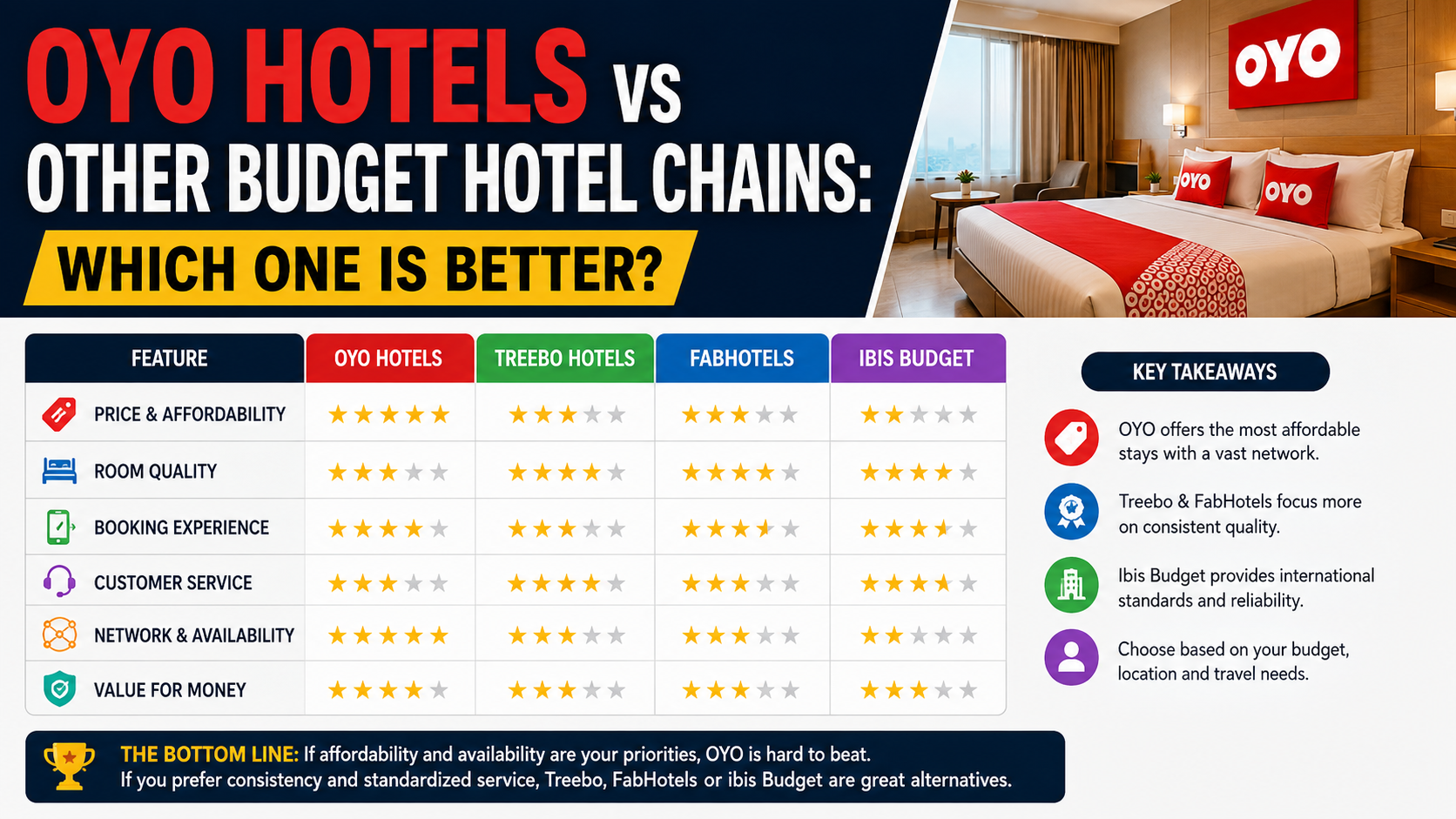
Comparing OYO and Other Budget Hotel Chains
Choosing between OYO and its competitors requires evaluating several factors. Price alone does not determine value. Travelers should also consider quality, convenience, customer support, and overall guest experience.
| Factor | OYO | Treebo | FabHotels | ibis Budget |
| Pricing | Very Competitive | Moderate | Moderate | Slightly Higher |
| Property Network | Extensive | Limited | Moderate | Limited |
| Standardization | Variable | Strong | Strong | Excellent |
| App Experience | Excellent | Good | Good | Good |
| International Presence | High | Low | Low | High |
| Budget Flexibility | Excellent | Good | Good | Moderate |
Pricing and Affordability
Price remains one of OYO’s biggest advantages. Travelers searching for the lowest available rates often find OYO properties among the most affordable options. The company’s dynamic pricing system adjusts room rates based on demand, seasonality, and local market conditions. This flexibility creates opportunities for significant savings, especially for last-minute bookings.
Competitors such as Treebo and FabHotels typically position themselves slightly above the lowest price segment. Their rooms may cost more, but many guests feel the additional expense is justified by better consistency. International brands like ibis Budget often charge even higher rates due to stricter operational standards and globally recognized branding.
Room Quality and Consistency
Room quality is perhaps the most debated aspect of the OYO experience. Because OYO operates through partnerships with independent hotel owners, quality can vary considerably between locations. Some OYO properties offer excellent value with clean rooms and professional service. Others may fail to meet expectations despite attractive online listings.
Competitors generally perform better in this category because they enforce stricter quality controls. Travelers who prioritize consistency often prefer Treebo, FabHotels, or international chains. These brands may have fewer properties, but they frequently deliver a more predictable experience.
Technology and Booking Experience
One area where OYO excels is technology. The company invested heavily in digital infrastructure, creating a user-friendly app and website that simplify hotel bookings. Features such as digital payments, instant confirmations, online check-in options, and customer support integration make the booking process convenient and efficient.
The company’s technology-first approach has contributed significantly to its growth and operational efficiency. Recent financial performance demonstrates how digital innovation continues supporting expansion and profitability. OYO reported strong revenue growth and multiple quarters of positive EBITDA performance while enhancing its hotel network and premium offerings.
OYO’s Strengths in 2026
OYO enters 2026 with several competitive advantages that distinguish it from other budget hotel chains. The company has successfully evolved beyond its original budget hotel focus and expanded into premium hospitality segments, vacation rentals, and international markets. Revenue growth and profitability improvements indicate stronger operational performance than in previous years.
Extensive Property Network
One of OYO’s greatest strengths remains its vast property network. Travelers can find OYO hotels in major metropolitan areas, smaller towns, tourist destinations, and emerging travel markets. This widespread availability makes OYO particularly attractive for spontaneous trips and destinations where alternative branded hotels may be limited.
The large network also increases pricing flexibility. Travelers can compare multiple OYO properties within the same location and choose accommodations that match their budget and preferences. This level of choice is difficult for smaller competitors to replicate.
Strong Digital Ecosystem
OYO’s investment in technology continues to provide a significant advantage. The company’s booking platform, revenue management systems, customer analytics, and operational tools help optimize occupancy and improve user experiences. These capabilities support both hotel partners and travelers, creating a scalable ecosystem that contributes to long-term growth.
Latest Post:




Areas Where Competitors Perform Better
Despite its strengths, OYO faces challenges that competitors often exploit. The primary concern remains consistency. Since OYO relies heavily on partner-operated properties, maintaining uniform standards across thousands of locations can be difficult.
Standardization and Quality Control
Brands such as Treebo and ibis Budget generally outperform OYO when it comes to standardization. Travelers booking these hotels often know exactly what to expect before arrival. This predictability reduces uncertainty and builds customer confidence. Consistent housekeeping, reliable amenities, and professional staff training contribute significantly to guest satisfaction.
Customer reviews frequently highlight quality variations across different OYO properties. While many experiences are positive, inconsistent standards can create frustration for travelers expecting identical experiences across all locations. This challenge remains one of the company’s biggest operational hurdles.
Premium Budget Experiences
Many modern travelers seek affordable accommodations that feel premium without carrying luxury price tags. Competitors increasingly target this segment by offering upgraded interiors, enhanced amenities, and superior guest services. These improvements appeal particularly to business travelers and families who prioritize comfort alongside affordability.
OYO has responded by expanding premium offerings such as Townhouse and other upgraded brands, but competitors still maintain strong positions in the premium-budget category. Travelers willing to pay slightly more often find attractive alternatives that emphasize consistency and elevated experiences.
Who Should Choose OYO?
OYO is an excellent choice for travelers prioritizing affordability, convenience, and property availability. Students, backpackers, solo travelers, and budget-conscious families often find significant value within the OYO ecosystem. The extensive network ensures accommodations are available in locations where other branded options may be limited.
Travelers comfortable researching reviews before booking can often discover excellent OYO properties that deliver exceptional value. By carefully selecting highly rated hotels, guests can enjoy comfortable stays at prices that are difficult for competitors to match. For frequent travelers who prioritize cost savings and flexibility, OYO remains one of the strongest options in the budget hospitality market.
Who Should Consider Other Budget Hotel Chains?

Travelers seeking maximum consistency may prefer alternatives such as Treebo, FabHotels, or ibis Budget. These brands generally offer more predictable experiences and stronger quality assurance processes. Business travelers attending important meetings, families traveling with children, and guests staying for extended periods often appreciate the added reliability.
Those willing to pay a modest premium may find that stricter operational standards justify the higher room rates. The reduced risk of unpleasant surprises can provide valuable peace of mind, particularly during important trips where comfort and reliability matter most.
Final Verdict
The answer depends largely on what matters most to the traveler. If affordability, availability, and booking convenience are top priorities, OYO remains one of the strongest budget accommodation platforms available today. Its massive network, technology infrastructure, and expanding hospitality portfolio continue strengthening its competitive position. Recent financial performance also suggests the company is becoming more operationally mature and profitable.
If consistency, quality assurance, and standardized experiences are more important, competing budget hotel chains often have an advantage. Treebo, FabHotels, and international brands generally provide more predictable stays, even if room rates are slightly higher.
Read More:-
ZoomInfo: The Complete B2B Lead Generation Tool for Marketers
How Xero Simplifies Accounting for Digital Marketing Businesses
How Similarweb Helps Marketing Agencies Analyze Competitors
Workable: The Best Recruitment Software for Marketing Agencies
Unbounce: The Best Landing Page Builder for Marketing Agencies
Conclusion
The debate between OYO and other budget hotel chains does not produce a single universal winner. Each brand serves different traveler priorities. OYO excels in affordability, accessibility, and digital convenience, making it ideal for budget-conscious guests seeking flexibility and extensive location coverage. Its continued growth, profitability improvements, and expansion into premium hospitality segments demonstrate that the company remains a major force in the global travel industry.
Other budget hotel chains often outperform OYO in consistency, quality control, and standardized guest experiences. Travelers who value predictability may find greater satisfaction with these alternatives. The smartest approach is to evaluate each trip individually. Consider your budget, destination, travel purpose, and comfort expectations before choosing a hotel brand. When used strategically, both OYO and its competitors can provide excellent value and memorable travel experiences.
Frequently Asked Questions
Q. Is OYO cheaper than other budget hotel chains?
A. In most cases, yes. OYO frequently offers highly competitive pricing and promotional discounts that make it one of the most affordable options available.
Q. Are OYO hotels reliable?
A. Many OYO hotels provide excellent experiences, but quality can vary by property. Reading recent guest reviews is highly recommended before booking.
Q. Which budget hotel chain offers the most consistent experience?
A. International brands such as ibis Budget and carefully curated chains like Treebo generally offer more consistent experiences.
Q. Is OYO growing in 2026?
A. Yes. OYO continues expanding its hospitality portfolio and has reported strong revenue growth and profitability improvements in recent financial periods.
Q. Should business travelers choose OYO?
A. Business travelers can find good OYO properties, but many prefer brands with stricter quality controls if reliability is a top priority.